
Setting The Old Testament Stage
When we read the Old Testament, the story is largely confined to a relatively small portion of the earth. Imagine an area about fifteen hundred miles on each side that sits at the meeting point of three continents: the southwestern edge of Asia, the southeastern edge of Europe, and the northeastern edge of Africa. This junction is where the Eastern Hemisphere’s three major land masses converge.
In modern terms the region includes what we call Asia Minor (today’s Turkey), the ancient cradle of civilization known as Mesopotamia, the lands of Syria and Palestine, the Arabian Peninsula, and Egypt. A few neighboring islands and peripheral territories also appear in the biblical record, but the core of the biblical story unfolds within this compact zone.
The “Bridge of the World”
At the center of this territory lies a narrow strip of land that stretches from the desert on its eastern side to the Mediterranean Sea on its western side. Historically this area is identified as Syria and Palestine. It measures roughly four hundred miles in length and varies between fifty and one hundred miles in width.
Because it physically links the largest continent, Asia, to the next largest, Africa, the region has long been called “the bridge of the world.” In antiquity travelers, merchants, and armies used this corridor to move between East and West, just as a bridge carries traffic across a river. Today the famous Suez Canal, located at the southern end of the same land, performs a similar function for the seas, joining the Mediterranean with the Red Sea. The geography therefore continues to serve as a crossroads for nations, cultures, and peoples.
Why the Land Matters for Scripture
Even though the story focuses heavily on Palestine, it would be a mistake to think that the entire biblical narrative is limited to that narrow strip. In fact, the book of Genesis, does not introduce the name “Canaan” (the biblical term for Palestine) until the twelfth chapter.
The early chapters of Genesis lay the groundwork for God’s people, whose story, in a sense, begins with Abraham. Called by God to settle in Canaan, Abraham’s life marks the start of Israel’s formation. The first eleven chapters supply the essential background—creation, humanity’s fall, the flood, and the Babel dispersion—that gives Abraham’s call its meaning.
The Tigris–Euphrates Basin and Mount Ararat
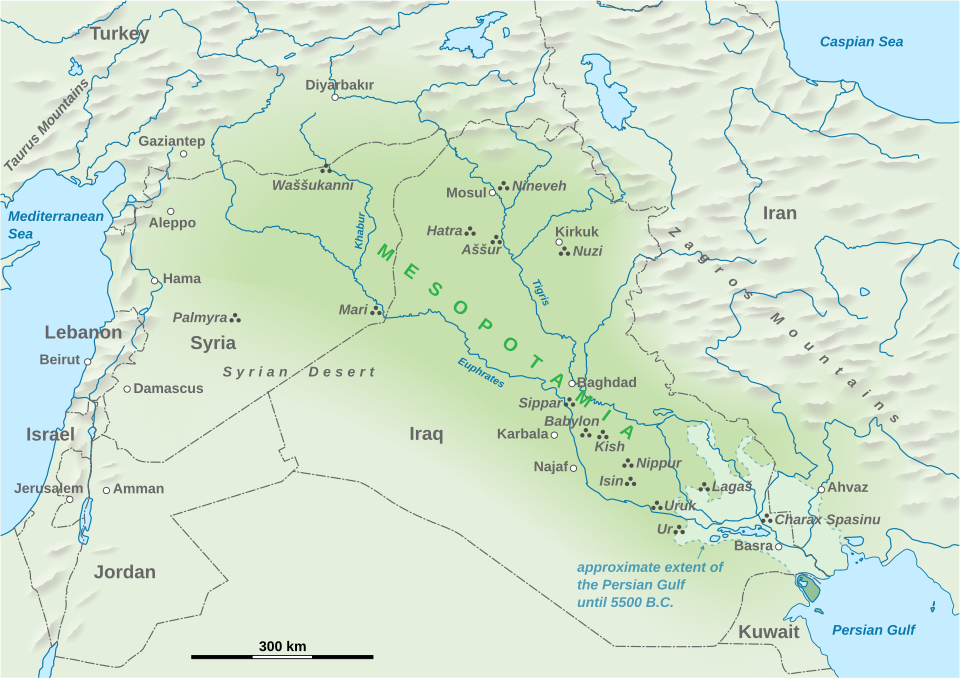
A key geographical feature mentioned in Genesis is the river that flows out of Eden to water the garden. The text identifies this river as the fourth of four “heads” of the river system, naming the Tigris (called “Hiddekel” in the Hebrew) and the Euphrates. These two waterways run through the southern part of what is now called Mesopotamia.
At the northern edge of this river basin rises the impressive mountain known as Mount Ararat. The biblical account of Noah’s Ark resting on the “mountains of Ararat” does not refer to a single peak but to the highlands of ancient Kurdistan, a region once called Urartu (Ararat).
Geographically, the area stretches from the Kurdish highlands in the north to the Persian Gulf in the south, bounded on the east by the Persian highlands and on the west by the great Syrian Desert. It is within this broad landscape that the earliest chapters of human history, as recorded in Scripture, take place.
The Days of Creation and the Dignity of Man
Genesis opens with a six‑day framework of creation that repeats the refrain, “God saw that it was good.” The climax of creation is humanity, the crowning work of the Creator. Made in the very image and likeness of God, man is declared “very good” on the sixth day. This declaration carries far more weight than the earlier statements about plants and animals; it affirms that humanity possesses a unique dignity and purpose.
God places man in a garden and gives him the charge to “work it and keep it” (Genesis 2:15). Adam, the first man, enjoys a position of dominion over the animal kingdom, a role of stewardship that prepares him to recognize a companion—woman—as a helper fit for him. Along with this privilege comes a clear warning: disobedience is the root of sin, and death is its inevitable result.
The Fall and Its Immediate Consequences
The narrative moves swiftly to the temptation by the serpent and the fall of the first couple. Their rebellion against God brings terror, shame, and punishment (Genesis 3). The consequences are not limited to Adam and Eve; sin spreads to their offspring, beginning with Cain’s murder of his brother Abel and continuing until God decides to cleanse the earth with a universal flood (Genesis 4, 6).
Even in the midst of judgment, God’s tender love for his wayward creation remains steadfast. God pronounces a promise that will echo through all of Scripture: He will “bruise the head of the serpent” (Rom 16:20, quoting Genesis 3:15). This prophetic utterance points to a future “seed of the woman,” a “Son of Man” who will ultimately defeat sin and death.
Hope Amidst the Curse
From the line of Seth—who was appointed in place of the slain Abel—a faithful genealogy emerges. In Enoch we see the possibility of walking in fellowship with God. In Lamech we see the the hope of each generation to be freed from the curse of the broken covenant. And in Noah, we see obedience to the command by God to build the Ark in contrast to Adam’s disobedience.
When the floodwaters recede, Noah and his family of eight become the sole survivors. God establishes a covenant with them, promising never again to destroy “all flesh” (Genesis 9:11). Yet the post‑flood world quickly reveals that divine judgment alone does not produce lasting reverence. Human pride resurfaces, leading the descendants of Noah to erect a tower intended as a rallying point for self‑worship.
God responds by shattering their unity. He confuses their language, scattering them across the earth (Genesis 11). This dispersal, while a judgment, also preserves the possibility of redemption by preventing a monolithic, sinful empire from forming. The narrative then highlights a line of faithful men descending from Noah through his son Shem, a line that continues to cherish God’s promises.
Preparing the Way for Abraham
The final verses of Genesis 1‑11 turn our attention to the family of Terah, a descendant of Shem. This brief introduction sets the stage for the next major figure in Scripture—Terah’s son Abraham, whom the New Testament calls “the friend of God.” By presenting the broad sweep of creation, fall, flood, and Babel, the storyline of Genesis equips us with the necessary background to understand the significance of Abraham’s call and the covenant that will follow.
Why the Early Chapters Matter
While the first eleven chapters provide a historical prelude; they are mainly theological foundation. They reveal God’s original design, humanity’s rebellion, and the pervasive reach of sin. Yet they also display God’s unchanging mercy, as seen in the promise to bruise the serpent’s head and the covenant with Noah. These themes echo throughout the entire bible, culminating in the person of Christ, the ultimate “seed of the woman.”
Understanding this tragic beginning helps believers grasp why God repeatedly intervenes in human history, why He institutes covenants, and why He ultimately fulfills His redemptive plan through Jesus. The drama of Genesis 1‑11 shows that, although sin introduced death and disorder, God’s purpose remains steadfast: to restore a fallen creation to the glory He originally intended.
Closing Thoughts
The early chapters of Genesis paint a sobering portrait of humanity’s fall and the ensuing consequences. Yet woven through the narrative is a thread of hope—a promise that God will not abandon His creation but will work toward its renewal. As we move beyond Genesis 11 into the story of Abraham and the nation of Israel, we do so with a clear understanding of the stakes involved and the depth of God’s commitment to redeem a world marred by sin. This foundational truth continues to shape the storyline of Scripture, reminding us that every chapter of the Bible is part of a single, unfolding redemptive drama centered on the glory of God and the salvation offered through Christ.
I encourage you, now, to read Genesis 1-11.